Sometime around 2020, someone might have pitched you a battery for one of your buildings. The upfront cost was high, the payback was long, and the savings rested on assumptions you didn't love. You passed, and at the time, that was the right call.But the economics are changing.
What if an underutilized portion of your commercial property could generate recurring income without the need for a major capital investment?
In the past few years, three things have changed:
- Power bills went up: commercial electricity prices rose nearly 30% between 2016 and 2025, and industrial prices rose about 28%, according to the U.S. Energy Information Administration.
- Data centers are increasing the demand pressure on the grid causing capacity shortages. PJM
- Batteries got cheap: the kind used for buildings and the grid hit a record low in 2025, falling by fell 50-70%, according to BloombergNEF.
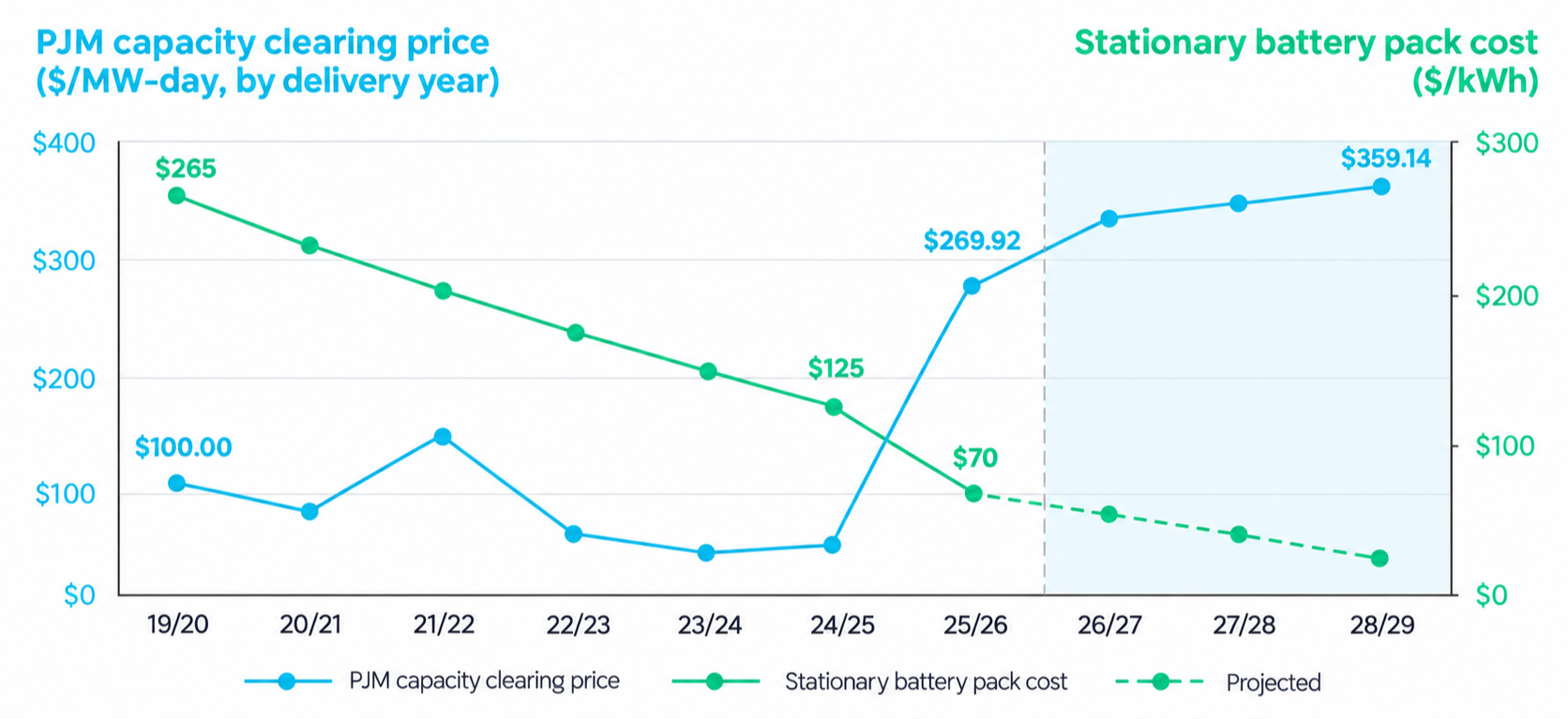
Source, PJM capacity prices. PJM 2029/2030 Base Residual Auction results. pjm.com. Source, battery hardware costs. BNEF 2024 Battery Cost Survey, battery pack prices. bnef.com. Note: battery costs are for hardware (battery pack) only and exclude inverter, balance of system, EPC, soft costs, and developer costs.
For the first time, what the grid needs most just got cheaper to build, and the customers paying for it have watched their bills climb for a decade. Scarcity, cost, and price all moved and now batteries pencil. For commercial real estate owners, this creates an opportunity to turn suitable, underutilized space into a new source of property income.
One of the most compelling aspects of battery storage is that commercial property owners don't necessarily need to buy, finance, or operate the equipment. Under a third-party development model, an energy developer can finance, install, own, and operate a battery system on a commercial property.
The property owner provides space and, in return, can receive recurring lease payments over the term of the agreement.
Why batteries are now an opportunity:
1. Electricity Demand Is Rising, and the Grid Needs More Flexibility
Electricity demand is growing rapidly, driven by data centers, manufacturing, and the electrification of buildings and transportation. At the same time, expanding electricity infrastructure is expensive and time-consuming. New power plants and transmission infrastructure can take years to develop.
Batteries can help bridge this gap.
A battery installed at a commercial property can store electricity when demand is lower and make power available during periods when the grid is under greater stress. Think of it as a reservoir for electricity: storing energy when it's abundant and releasing it when it's most valuable.
Utilities and grid operators increasingly compensate battery operators for providing this flexibility.
For commercial real estate owners, this means their properties may have value beyond the electricity they consume. Their location and access to the electric grid can become valuable assets in their own right.
2. New Revenue Opportunities Are Improving Battery Economics
Historically, commercial batteries were primarily evaluated based on their ability to reduce electricity bills. Today, batteries may generate revenue from multiple sources:
- Grid capacity payments: Compensation for making power available during periods of high electricity demand.
- Demand response programs: Payments for reducing electricity drawn from the grid when requested.
- Electricity cost savings: Using stored energy during expensive periods to lower utility bills.
- Energy market participation: Earning revenue by providing electricity and other services to the grid, where permitted.
These opportunities vary by electricity market, utility, and program eligibility. In certain regions, such as the PJM electricity market covering parts of the Mid-Atlantic and Midwest, rising capacity prices have made the ability to supply power during critical periods increasingly valuable. Combined with declining battery equipment costs, these developments are improving the financial outlook for commercial energy storage.
The important shift is that a battery's value is no longer necessarily limited to the electricity savings it can deliver to a building. It can also earn revenue by supporting the broader grid.
3. Falling Battery Costs Are Making More Projects Economically Viable
Battery technology has become substantially more affordable, helping improve project economics. But hardware costs are only part of the equation.
Historically, developing a commercial battery project has involved considerable time and expense. Developers must evaluate property suitability, utility infrastructure, local permitting requirements, available incentive programs, and potential revenue streams. Often, when analyzing hundreds of properties there are only a handful of viable opportunities.
These costs can be particularly challenging for smaller commercial projects. Reducing the time and expense required to identify, evaluate, and develop projects is therefore essential to making battery storage accessible to more property owners. That's where technology and automation are changing the development process.
The question now isn’t “Why”, it’s “Where?”
Five years ago, passing on a battery was the right call. Today the math looks different. Power bills have climbed for a decade, demand on the grid is outpacing new power plants, and batteries have never been cheaper. Together, those shifts have turned grid flexibility into something utilities and grid operators will pay for, and turned well-located commercial property into a place to provide it.
For many owners, that means unused space can become recurring lease income without buying, financing, or operating anything. The opportunity isn’t the same at every site, so the first step is finding out which of your properties qualify.
